

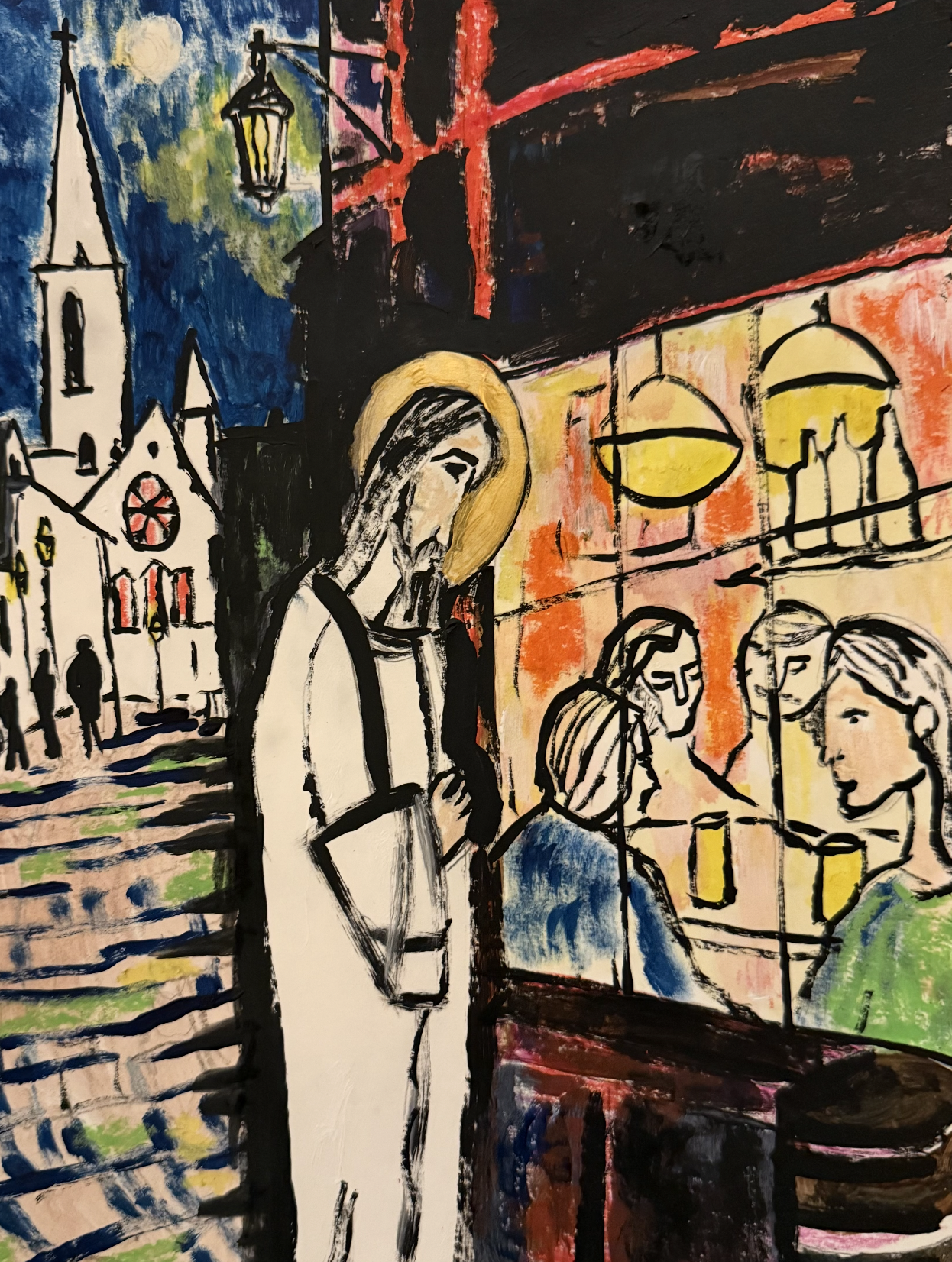
Painting & Visio Divina Reflection by John DelHousaye
1. Presence — Becoming Aware
We spend much of our lives looking without really seeing. Our attention moves from one thing to another, often without our awareness. For the next ten minutes, I invite you to practice visio divina (“sacred seeing”). This is not an exercise in art criticism or a test of our ability to discover hidden meanings, but an invitation to become present—to ourselves, the world, and God.
Settle into your chair. Feel your feet resting on the ground. Breathe slowly. Become aware of yourself here, in this moment. And remember these words:
“Before you look for Jesus, remember this: You are already being seen.”
We do not have to earn God’s attention. We are already known. Already seen. Already loved.
[Silence]
2. Perception — Learning to Look
Now turn your attention to the painting. Allow your eyes to wander slowly across the image. Notice the colors, the shadows, the people, the buildings. There is a church in the background. There are people gathered around a window. And there is Jesus, standing quietly in the midst of the scene. What first catches your attention? Don’t try to explain it. Simply notice what you notice.
[Silence]
Now look again. What did you overlook the first time? Perhaps a face, a gesture, or something in the background. Notice where your attention naturally rests.
[Silence]
3. Reflection — Seeing Christ in the Ordinary
Notice where Jesus stands. He is not inside the church. He is standing along the street, among ordinary people going about their lives. Consider these words:
“The God made visible in Jesus is not confined to pulpits, sanctuaries, or sacred moments. He is present at tables and on sidewalks, in kitchens and bars, among friends and strangers, in bread broken and stories shared.”
Look again at the painting. What might Christ be attending to? Who might he be noticing?
[Silence]
Now become aware of your own response. What feelings arise as you look at Jesus? Peace? Curiosity? Longing? Discomfort? Perhaps you feel nothing in particular. There is no correct response. Simply receive what is happening within you.
[Silence]
4. Dialogue — Being Seen by Christ
Now imagine yourself entering the painting. Where would you be? Walking down the street? Standing among the people? Approaching Jesus? Imagine yourself there.
[Silence]
Now imagine that Jesus turns toward you. Before you have said anything, he sees you. Not merely your appearance, accomplishments, or responsibilities. He sees your whole life. Your joys and sorrows, hopes and fears. The things you reveal to others and the things you keep hidden. What might it mean to receive his loving attention?
[Silence ]
If you could speak to Jesus right now, what would you say? Perhaps you have a question . . . something to confess . . . something for which you are grateful. Allow your response to become a simple prayer.
[Silence]
5. Rest and Return — Becoming the Presence of Christ
As we conclude, look once more at the painting and consider these words:
“Look for Christ in the face across from you. Listen for him beneath the noise. Make room for the person others overlook. Receive the ordinary as holy ground.”
[Silence]
The Christian life is seeing Jesus and becoming a people through whom the invisible love of God becomes visible. Between the pulpit and the pub, between worship and work, between Sunday and everything else.
Let us pray.
Lord Jesus Christ,
Thank you for seeing us before we ever thought to look for you.
Open our eyes to your presence in the ordinary places of our lives.
Teach us to recognize your image in the faces of others.
Make our attention an expression of love.
And through our lives, may your invisible love become visible.
May Jesus be seen.
Amen.